If you look at cell phones: the Motorola 30 edge ultra has a 200 MP camera. iPhone 15 Pro Max has 3 cameras: one 48 megapixel and two 12 megapixel cameras. What does that all mean?
Providing a telephoto on a cell phone is a bit of a problem since you don’t want the lens protruding out so far that you have trouble putting it in your pocket (or purse). One answer is to have a large megapixel sensor and digitally zoom (i.e. crop in to get more telephoto). There is a problem with that: the smaller the sensor area, the poorer the quality (sensor size matters for getting cleaner images).
If you look at the specifications for the iPhone 15 pro max, it says it has a 10 times optical zoom and 25 times digital zoom. That’s not entirely true because none of the 3 lenses are zoom lenses – they are all fixed (what I would refer to as ‘prime’ lenses – which are simply lenses that don’t zoom). The three lenses have three different focal lengths and the iPhone digitally zooms between them to give you the so-called ’10 times optical zoom’. You get the additional 15 times (to make 25 times digital zoom) by digitally zooming (or simply cropping) with the lens that has the longest focal length.
The total focal length range for the iPhone 15 pro max is 13 mm to 120 mm for the so-called ‘optical zoom’ and up to 325mm with digital zoom. That’s actually pretty impressive – but there is an equally impressive price tag that goes with that.
My iPhone SE is much less impressive. It has a single 32 mm lens and allows for a 5 x digital zoom with a 12 MP sensor. It’s even less impressive than that because I dropped it on the floor and broke the lens.
If you look at interchangeable lens cameras (ILCs), there are various sensor sizes but the main ones are holdovers from film days: full frame (sensor size the same as 35mm film) and APS-C, sometimes referred to as a cropped sensor, which has a smaller sensor area. Sensor sizes and lens focal lengths are often given in reference to a full frame equivalent. When they say my iPhone SE has an equivalent focal length of 32 mm, it doesn’t mean that the focal length is 32 mm; it means that it gives the same angle of view as a 32 mm lens on a full frame camera. You can calculate the actual focal length by dividing equivalent focal length by the crop factor which is a ratio of the area of a full frame sensor to the actual iPhone SE sensor. That number for the iPhone SE around 7 which means that the sensor size of the iPhone SE camera is 1/7th the size of a full frame sensor. The actual focal length of the lens which they say is equivalent to 32 mm is actually 32/7 or 4.6 mm.
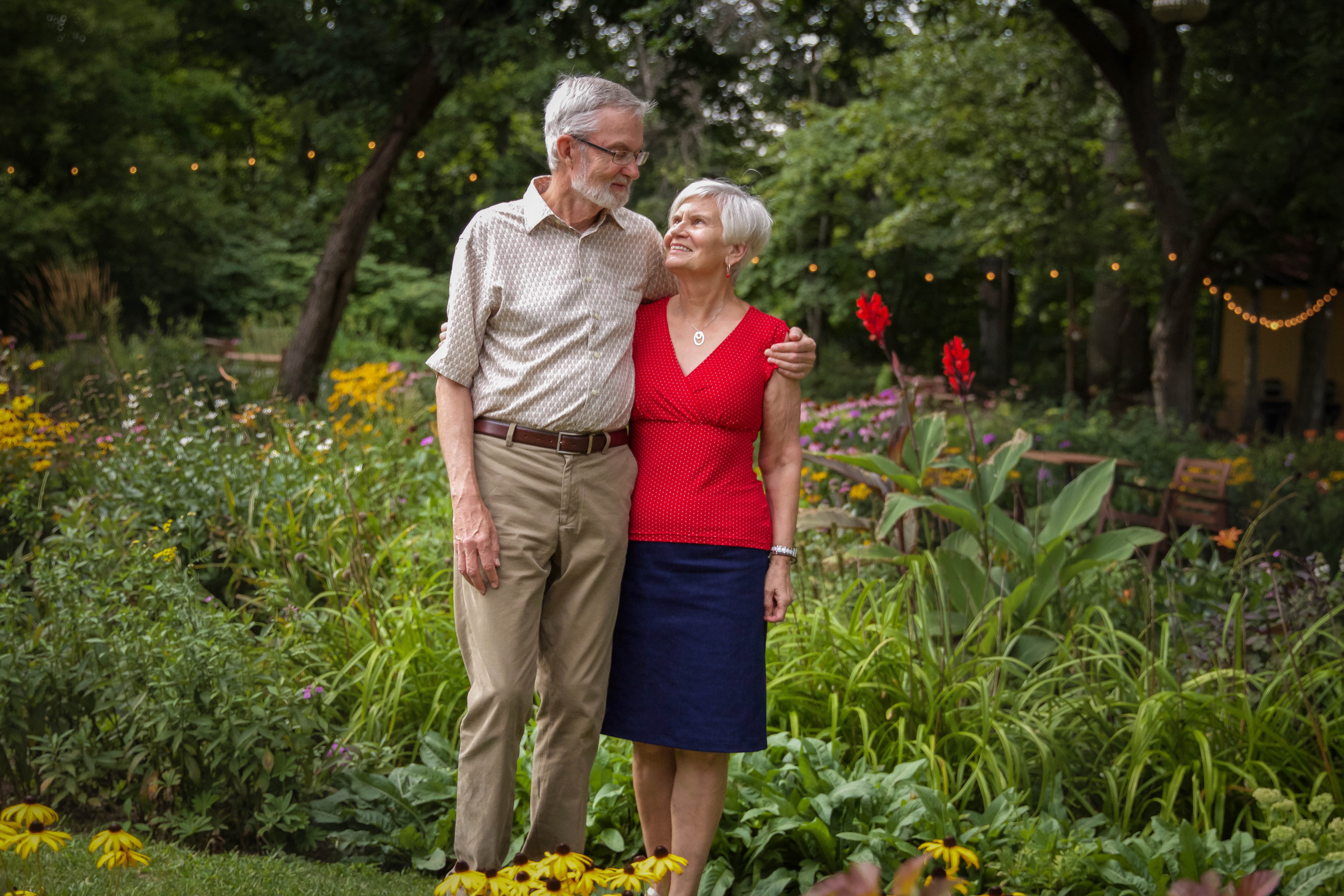
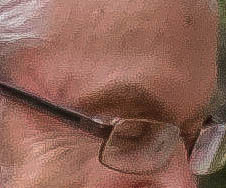
As far as ILCs go, most professionals use a full frame camera, mainly because the larger sensor gives a cleaner image than a cropped APS-C sensor (crop factor of 1.5). Canon and Nikon tend to build big cameras, I assume this is because big cameras appear to be more professional. Bigger doesn’t mean better though. Back in 2017 at our 25th anniversary, we hired a new professional who hadn’t read the memo. The photographer used a Canon 60D (a big camera) with a 24-70mm f2.8 full frame lens set at f 2.8. the lens was OK (typical) but the camera is a cropped sensor with a 1.5 crop factor. That meant the lens was really equivalent to 24 x 1.5 to 70 x 1.5 or 36-105mm. That’s probably OK-ish but the photos were taken in the shade. They would look fine on instagram or facebook but not if you print them to any size. I have included one of the shots with a crop to show you what part of it looks like blown up. The level of noise is because of the smaller sensor.
On a normal day where there is enough light with few shadows the sensor size is not as important. If it is cloudy, in the shade or there are deep shadows, sensor size will matter. A larger sensor will have less noise and you will be able to pull more detail out of the shadows.
Most professionals use full frame while enthusiasts like myself may use full frame or cropped (APS-C). The APS-C cameras are smaller and have smaller less expensive lenses. The typical number of megapixels is 24. The Sony Sports alpha 9 series is still 24 MP. The Sony 6700 APS-C camera is 26 MP (the previous 6600 model was 24 MP).
Most professionals that take photos of people or products would use of the Sony A7 series. The newest (version 4) now has 33 MP while the previous version had 24 MP.
I use Sony R series full frame cameras which are now 61 MP. I can use either full frame or the smaller (APS-C) lenses on the camera. With an APS-C lens, the camera becomes a 26 MP camera – the same as the Sony 6700. Basically it gives me two cameras in one. It also allows me to use more prime lenses on the camera and digitally zoom (i.e. crop). Primes are less expensive, smaller, optically better, and let more light in. All my prime lenses and all my zooms under 70mm (I only have two: 20-70mm and 16-35mm) are full frame lenses. All my walkabout and telephoto zooms (3 of them) are smaller APS-C lenses. The one exception is a 150-500mm lens which is full frame, which if I run it in crop mode gives me 225-750mm. I only use that lens on the rare occasion that I go out to take photos of birds or other wildlife.
See the photos below taken by a photographer on a Canon 60D cropped sensor camera.
 WR Foster