I rarely say anything about cameras because for most people it is not useful information. The best camera is the one you already own and for the majority, that’s the camera on their phone. Even if you still use a camera that takes interchangeable lenses, the investment in lenses prohibits changing brands – unless there is a transition in technology which was my case.
Back in the day of film cameras, the most popular professional type of camera was a single lens reflex or SLR. The idea behind the SLR is that when you look into the viewfinder, there is a prism and mirror that allows you to look through the attached lens. When you fully depress the shutter button to take the photo, the mirror moves out of the way in order for the light from the lens to expose the film.
When things turned digital, the majority of camera manufacturers replaced the film with a digital sensor but kept the SLR technology. The acronym for the camera changed from SLR to DSLR (digital SLR).
Point and shoot cameras, on the other hand, have always been mirrorless (i.e. not SLRs). If the point and shoot camera has a viewfinder – it is a tiny screen showing the output of the sensor so what-you-see-is-what-you-get. In DSLR’s, if your settings are wrong and the shot is under-exposed or over-exposed, you won’t know about it until after you take the shot and look at the result (i.e. it is not WYSIWYG).
Back in the film days, for many of us photographer wannabes that either didn’t have the money or didn’t want to spend it on a full frame 35mm camera, manufacturers produced a camera with smaller film that had smaller and cheaper lenses. That type of camera was and is called an APS-C camera and continues today in the digital world.
I had always used Canon cameras during the film days and stayed with Canon when DSLRs came out. The big two camera manufacturers were always Nikon and Canon. Sony didn’t get into the camera business until 2006 when it bought up Minolta. Sony immediately brought out a line of DSLRs to compete with Canon and Nikon.
In 2013, Sony brought out the first full frame 35mm interchangeable lens mirrorless cameras – the Sony alpha 7 and the Sony alpha 7R (R for resolution with a 42 megapixel sensor). I bought the 7R and an adapter for my Canon lenses and sold my Canon cameras. For some time I shot using Canon lenses with the Sony camera. Eventually, I sold off the Canon lenses and replaced them with Sony equivalents.
Canon is still the premier brand that sells the most cameras and lenses but now Sony is second and Nikon is 3rd.
For my needs, Sony is the better camera company. The writing was on the wall that DSLRs were doomed when Sony came out with the first full-frame 35mm mirrorless camera but Canon insisted that mirrorless cameras would never be as fast as DSLRs. The reality is that Canon wanted to keep selling all the lenses they had developed over the years. Switching to mirrorless would require an enormous effort to re-develop all new lenses. It took 5 more years before Canon and Nikon brought out full frame mirrorless cameras and only after Sony announced a mirrorless camera that was faster than Canon’s fastest DSLR.
Canon does not support 3rd party lenses. That may be fine for professionals but for the rest of us there are some types of lenses that are very useful but which the prime camera manufactures do not make. Third party lenses are often less expensive as well. A case in point is the zoom lens I have on this trip which is a Sigma 20-200mm. Sigma doesn’t make that lens for Nikon or Canon. That is not to say that you can’t buy third party lenses for Canon – you can – but those manufacturers have had to reverse engineer the Canon lens mount (no help from Canon).
In my world, dynamic range is king (or queen) and Sony is the king (or queen) of dynamic range. Sony is also the resolution leader and the best in subject recognition and autofocus. If you ware taking a photo of people , animals or insects you want to focus on the eyes. Sony cameras can focus on the eye of a bee several meters away.
Sony has 4 main lines of full-frame cameras: top-of-the line do everything, sports line, regular line (wedding photographers etc) and R (high resolution line). In addition they have their compact cameras (regular and R).
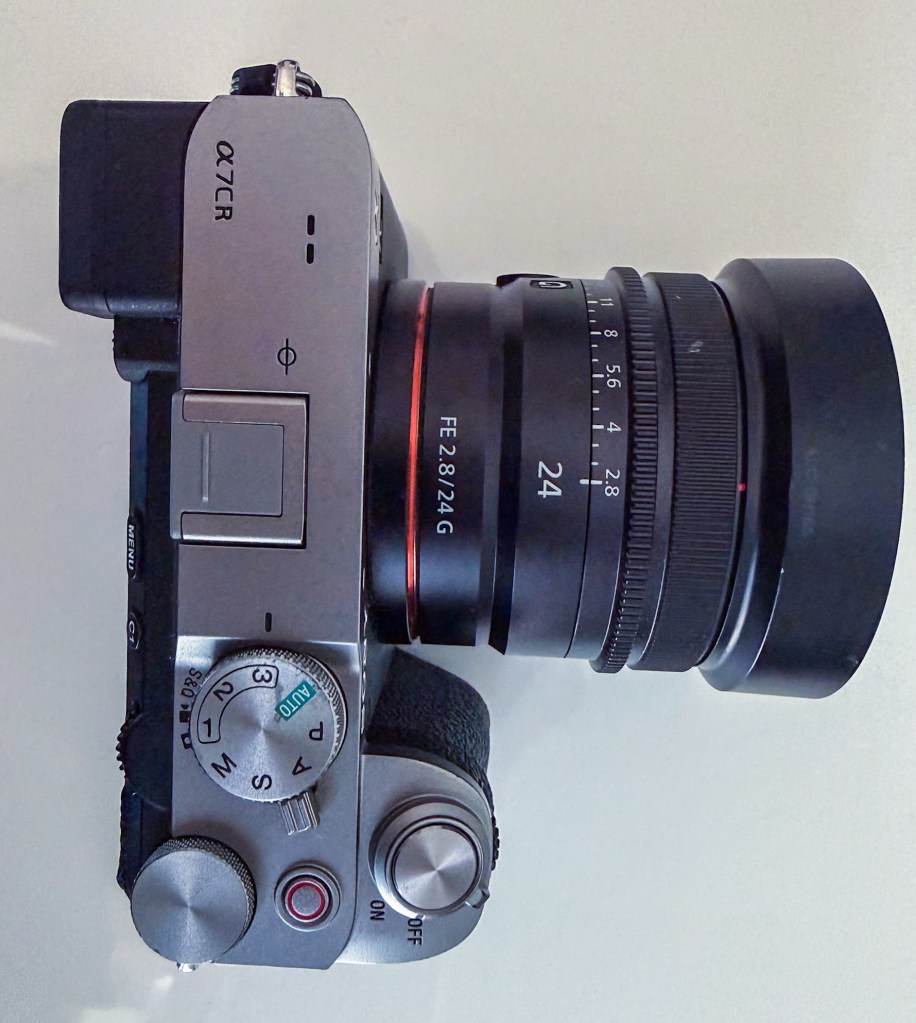
I have two Sony bodies – both high resolution (61 mp) – one is the compact version of the other. I use the compact for travel and for photos of people (photo below with my 24mm f2.8 lens). These cameras double as 26 mp APS-C cameras and I have a couple of APS-C lenses that I use on a regular basis.
I had three lenses on this trip – a Sony 24mm f2.8, a Viltrox 14mm f4 and a Sigma 20-200mm f3.5-6.3. I tend to use the 20-200mm during the day and the 24mm in the evening. The 14mm was used on several days in Cinque Terre. The advantage of having a high resolution camera is that you can go around with a smaller lens and zoom by cropping. Less lenses do more – so I now have about half as many lenses as I did a few years ago.